
Beyond deburring: how controlled edge geometry can support NVH consistency, fatigue performance, heat treatment and manufacturing repeatability.
As manufacturers pursue quieter, more efficient and more power-dense transmissions, apparently minor details in gear production are becoming increasingly important. One such detail is the condition of the gear’s edges.
Deburring has traditionally been regarded as a necessary finishing operation: remove unwanted material, prevent handling injuries and ensure the component can progress to the next manufacturing stage. Precision edge shaping goes further. Instead of simply making a component “burr-free”, it creates a controlled and repeatable chamfer or radius designed to improve manufacturing consistency and in-service performance.
The growing NVH challenge
Noise, vibration and harshness – commonly known as NVH – is a particular challenge in electric vehicles. EV powertrains are generally quieter than combustion engines, but this does not mean they are free from unwanted noise. In fact, the absence of engine noise makes previously masked sounds considerably more noticeable.
Electric drive units operate across a wide speed range and deliver torque almost instantaneously. Their reduction gears can therefore generate distinctive high-frequency tonal noise, generally perceived as gear whine. Regenerative braking also reverses the direction of load through the transmission, requiring gears to perform effectively on both their drive and coast flanks.
The principal sources of gear whine usually include transmission error, tooth-flank microgeometry, gear and shaft alignment, bearing stiffness and structural resonance within the housing. Precision edge shaping cannot replace accurate gear design, grinding or honing. It can, however, eliminate uncontrolled edge conditions that introduce additional excitation or create abnormal contact.
Residual burrs may interfere with tooth engagement, while inconsistent chamfers or sharp transitions can contribute to localised loading. Loose burrs can also detach in service, contaminating the lubricant and potentially damaging gear flanks or bearings. Producing a consistent edge condition can consequently reduce component-to-component variation and help prevent individual transmissions from exhibiting unusually prominent noise.
For EV applications, this consistency can be particularly valuable. The benefit may not simply be a lower average sound level, but a reduction in end-of-line failures, rejected drive units and warranty claims caused by occasional high-noise components.
A stronger case beyond NVH
Although improved NVH consistency is valuable, the most compelling reasons for precision edge shaping are frequently associated with fatigue performance, heat treatment, cleanliness and manufacturing repeatability.
Gear teeth operate under demanding cyclic loads. A sharp edge, residual burr or machining defect can create a local stress concentration and potentially act as a crack-initiation site. Creating a controlled transition at the appropriate locations can improve the consistency of fatigue performance, particularly in highly loaded aerospace, automotive, motorsport and industrial gear systems.
Edge preparation can also be important before carburising or other heat-treatment processes. Sharp edges may respond differently from the main body of the component, potentially producing brittle regions, excessive carbon concentration, distortion or microcracking. A repeatable chamfer or radius established before heat treatment can help produce a more uniform and predictable result.
After hard finishing, the financial case becomes even stronger. By this stage, significant value has already been added to the gear through machining, heat treatment, grinding and inspection. Conventional mechanical deburring can risk damaging a finished flank, rounding critical geometry, introducing unwanted stress or creating secondary burrs. Scrapping a component at this point is particularly costly.
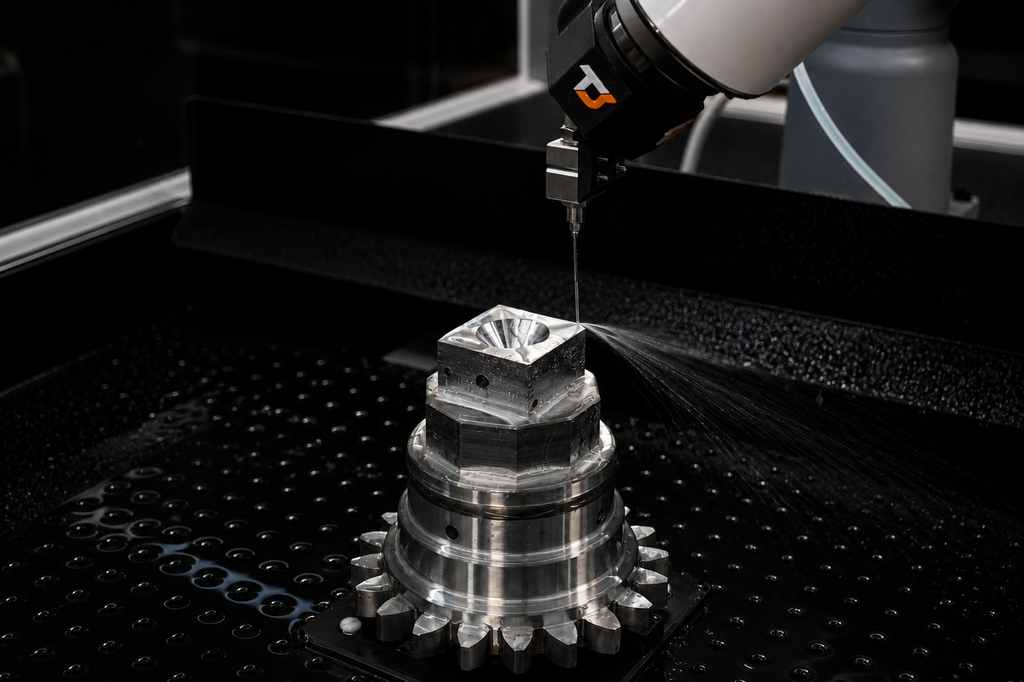
Precision, non-contact edge shaping offers the potential to remove tenacious burrs while protecting adjacent functional surfaces. This can reduce manual intervention and improve repeatability across production volumes.
Internal features and complex geometries
Some of the strongest applications are not found on the external tooth edges at all. Gears and transmission components frequently contain intersecting oil holes, cross-holes, internal splines, undercuts and other features that are difficult to access using conventional tooling.
Burrs within an oil passage can restrict lubricant flow or break away during operation. Burrs at intersecting features can also create stress concentrations or compromise component cleanliness. These areas may be difficult to inspect and are often dependent on manual finishing, introducing variation between operators and components.
Selective electrochemical processes are particularly relevant to these applications. Because material can be removed without conventional cutting forces or direct mechanical contact, it becomes possible to target difficult features without deforming the component, producing secondary burrs or mechanically damaging nearby surfaces.
From manual deburring to controlled manufacture
To unlock these benefits, edge condition must be treated as a defined engineering characteristic rather than a subjective finishing requirement. A specification of “burr-free” leaves considerable room for variation. A more robust approach defines measurable parameters such as chamfer width, edge radius, symmetry, transition quality and allowable component-to-component variation.
This changes deburring from a manual clean-up operation into a controlled manufacturing process.
- more consistent fatigue and heat-treatment performance;
- reduced risk of loose-particle contamination;
- protection of high-value finished components;
- lower levels of manual rework and inspection;
- improved automation and process traceability;
- reduced scrap and end-of-line rejection;
- more consistent NVH behaviour in completed transmissions.
Precision edge shaping is therefore relevant across EV reduction gears, aerospace transmissions, planetary systems, differential gears and components containing internal splines or intersecting lubrication passages.
Precision edge shaping should be viewed not simply as burr removal, but as the controlled manufacture of an engineered edge.
Its role in reducing gear noise should remain technically balanced: it is one part of a much wider NVH strategy. Its broader manufacturing value, however, is considerably stronger. By replacing uncontrolled burr removal with repeatable edge geometry, manufacturers can improve component reliability, production consistency and the performance of increasingly demanding transmission systems.